
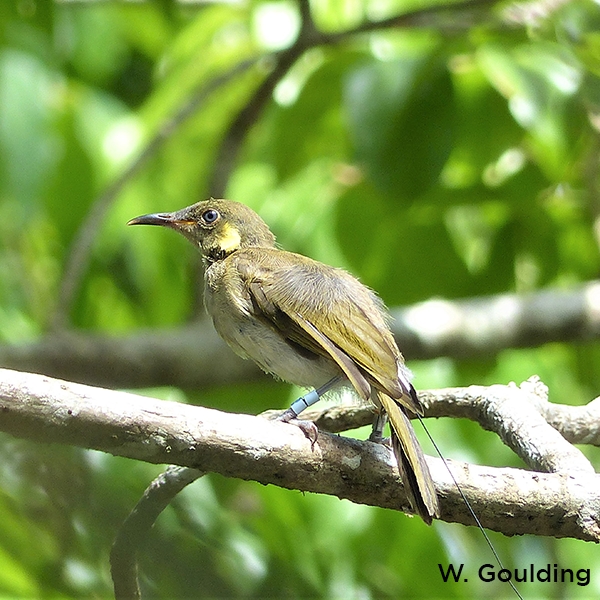
Multiple individuals incubating and nest building, and winter breeding, in the Black-chinned Honeyeater Melithreptus gularis
Richard A. Noske
Abstract
References
Archard, G.A., Robertson, R.J., Jones, D., Painter, J., Crozier, R. & Clarke, M.F. (2006). Brooding behaviour in the cooperatively breeding Bell Miner (Manorina melanophrys). Emu 106, 105–112.
Arnold, K.E. & Owens, I.P.F. (1998). Cooperative breeding in birds: A comparative test of the life history hypothesis. Proceedings of the Royal Society, London B 265, 739–745.
Austin, S.H., Robinson, W.D., Ellis, V.A., Robinson T.R. & Ricklefs, R.E. (2019). Nest attendance by tropical and temperate passerine birds: Same constancy, different strategy. Ecology and Evolution 9, 13555–13566.
Barker, R.D. & Vestjens, W.J.M. (1991). The Food of Australian Birds. 2. Passerines. CSIRO, Canberra.
Boekel, C. (1980). Birds of the Victoria River Downs Station and of Yarralin, Northern Territory. Part 2. Australian Bird Watcher 8, 205–211.
Brent, A.E. (1905). The Black-headed Honey-eater (Melithreptus melanocephalus). Emu 5, 12–15.
Burgess, W. (1947). The Pied Honeyeater breeding in Victoria. Emu 46, 392–393.
Clarke, M.F. (1988). The reproductive biology of the Bell Miner Manorina melanophyrs. Emu 88, 88–100.
Clarke, M.F. (1995). Co-operative breeding in Australasian birds: A review of hypotheses and evidence. Corella 19, 73–90.
Conway, C.J. & Martin, T.E. (2000a). Effects of ambient temperature on avian incubation behavior. Behavioral Ecology 11, 178–188.
Conway, C.J. & Martin, T.E. (2000b). Evolution of passerine incubation behaviour: Influence of food, temperature, and nest predation. Evolution 54, 670–685.
Cooper, R.M., McAllan, I.A.W., Brandis, C.C.P. & Curtis, B.R. (2020). An Atlas of the Birds of New South Wales and the Australian Capital Territory, Volume 3 – Eastern Spinebill to Common Greenfinch. NSW Bird Atlassers Inc., Sydney.
Dow, D.D. (1978). Reproductive behaviour of the Noisy Miner: A communally breeding honeyeater. Living Bird 16, 163–185.
Eddy, R.J. (1961). Twenty years of the Painted Honeyeater. Australian Bird Watcher 1, 122–128.
Elsworth, S. (1997). Observation of Black-chinned Honeyeaters breeding in the Hackham area during July/August 1994. South Australian Ornithologist 32, 170.
Ford, H.A. & Paton D.C. (1977). The comparative ecology of ten species of honeyeaters in South Australia. Australian Journal of Ecology 3, 399–407.
Ford, H.A., Watson, D.M., Tulloch, A.I.T., Barnes, M.D., Maron, M., Oliver, D.L. & Garnett, S.T. (2021). Black-chinned Honeyeater Melithreptus gularis. In: Garnett, S.T. & Baker, G.B. (Eds). The Action Plan for Australian Birds 2020, pp. 600–602. CSIRO Publishing, Melbourne.
Garnett, S.T., Szabo, J.K. & Dutson, G. (2011). The Action Plan for Australian Birds 2010. CSIRO Publishing, Melbourne.
Gilbert, P.A. (1919). The Black-throated Honey-eater (Melithreptus gularis). Emu 19, 28–33.
Gilbert, P.A. (1937). Field notes from New South Wales. Emu 37, 28–31.
Harrison, C.J.O. (1969). Helpers at the nest in Australian passerine birds. Emu 69, 30–40.
Herman, K. (2005). The Ecology of the Black-headed Honeyeater Melithreptus affinis in Tasmania, Australia. PhD Thesis. University of Tasmania, Hobart.
Higgins, P.J., Peter, J.M. & Steele, W.K. (Eds) (2001). Handbook of Australian, New Zealand & Antarctic Birds, Volume 5: Tyrant-Flycatchers to Chats. Oxford University Press, Melbourne.
Hindwood, K.A. (1937). The Black-chinned Honeyeater. Emu 37, 143.
Johnstone, R.E. & Storr, G.M. (2004). Handbook of Western Australian Birds, Volume II. Passerines (Blue-winged Pitta to Goldfinch). Western Australian Museum, Perth.
Lavery, H.J., Seton, D. & Bravery, J.A. (1968). Breeding seasons of birds in north-eastern Australia. Emu 68, 133–147.
Lollback, G.W. (2007). Ecology of an Uncommon Species, the Black-chinned Honeyeater (Melithreptis gularis gularis), in North-eastern New South Wales. PhD Thesis. University of New England, Armidale, NSW.
Lollback, G.W., Ford, H.A. & Cairns, S.C. (2008). Is the uncommon Black-chinned Honeyeater a more specialised forager than the co-occurring and common Fuscous Honeyeater? Emu 108, 125–132.
Longmore, W. (1991). Honeyeaters and Their Allies of Australia. The National Photographic Index of Australian Wildlife. Angus & Robertson, Sydney.
Marchant, S. (1986). Nesting notes on the White-naped Honeyeater. Australian Birds 20, 52–55.
Marki, P.Z., Jønsson, K.A., Irestedt, M., Nguyen, J.M.T., Rahbek, C. & FjeldsÃ¥, J. (2017). Supermatrix phylogeny and biogeography of the Australasian Meliphagides radiation (Aves: Passeriformes). Molecular Phylogenetics and Evolution 107, 516–529.
Martin, T.G., Joseph, L.N. & Possingham, H.P. (2003). Black-chinned Honeyeaters (Melithreptus gularis) stealing Koala (Phascolarctos cinereus) fur to build a nest. Sunbird 33, 29–32.
Matysioková, B. & RemeÅ¡, V. (2014). The importance of having a partner: Male help releases females from time limitation during incubation in birds. Frontiers in Zoology 11, 24.
Matysioková, B. & RemeÅ¡, V. (2018). Evolution of parental activity at the nest is shaped by the risk of nest predation and ambient temperature across bird species. Evolution 72, 2214–2224.
McGilp, N. (1932). Some birds of the interior. South Australian Ornithologist 11, 222–225.
Moffat, D, Whitmore, M.J. & Date, E.M. (1993). Communal breeding by Striped Honeyeaters. Emu 83, 202–203.
North, A.J. (1907). Nests and Eggs of Birds Found Breeding in Australia and Tasmania, Volume 2. Special Catalogue No. 1. Australian Museum, Sydney.
Noske, R.A. (1983). Communal behaviour of Brown-headed Honeyeaters. Emu 83, 38–41.
Noske, R.A. (2021). New localities for nine bird species in Arnhem Land, including those for the notable Gouldian Finch, Red Goshawk and Hooded Robin. Northern Territory Naturalist 30, 50–70.
Paton, D.C. (1980). The importance of manna, honeydew and lerp in the diets of honeyeaters. Emu 80, 213–226.
Priday, S. (2015). Habitat of the Black-chinned Honeyeater Melithreptus gularis in the Greater Brisbane region, Queensland. Sunbird 45, 48–59.
Rowley, I. (1976). Co-operative breeding in Australian birds. Proceedings of the 16th International Ornithological Congress 16, 657–666.
Schodde, R. & Mason, I.J. (1999). The Directory of Australian Birds: Passerines. CSIRO Publishing, Melbourne.
Slater, P. (1962). Western Australian Birds. Mercantile Press, Perth, for BP Pty Ltd, Kwinana, WA.
Storr, G.M. (1984). Revised list of Queensland birds. Records of the Western Australian Museum Supplement. 19, 1–189.
Toon, A., Hughes, J.M. & Joseph, L. (2010). Multilocus analysis of honeyeaters (Aves: Meliphagidae) highlights spatio-temporal heterogeneity in the influence of biogeographic barriers in the Australian monsoonal zone. Molecular Ecology 19, 2980–2994.
Trémont, S. & Williams, B. (1999). Observations at nests of the Painted Honeyeater Grantiella picta. Australian Bird Watcher 18, 49–58.
Whitmore, M.J. & Eller, C.M. (1983). Observations at a nest of Painted Honeyeaters. Emu 83, 199–202.
Wood, K.A. & Ley, A.J. (2005). Nesting and foraging by a pair of Striped Honeyeaters at Baradine, New South Wales. Australian Field Ornithology 22, 88–103.