
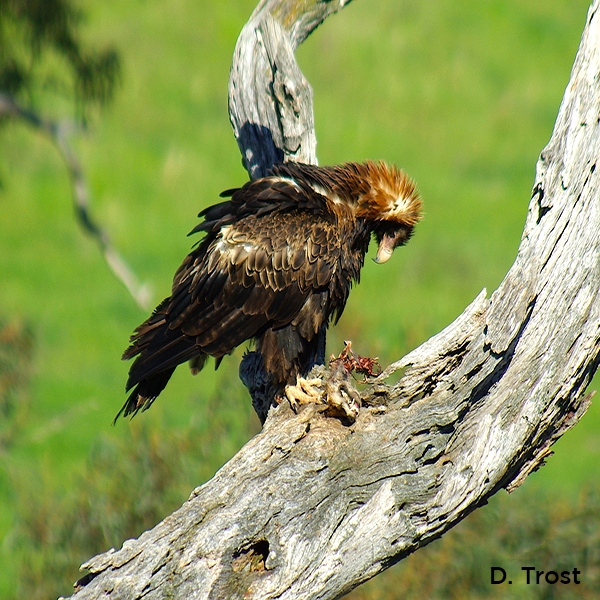
Plumages and Moult of the Little Eagle Hieraaetus morphnoides
S J S Debus
P. 103-113
Abstract
The plumages, age criteria and moult of the Little Eagle Hieraaetus morphnoides were investigated from museum skins, captive birds and field studies in north-east New South Wales. Characteristics of juveniles, second-year birds and adults of both morphs are discussed: these relate mainly to the colour of the head and underparts (juveniles more rufous than adults of their respective morphs); the amount of black streaking on the crown, crest and underparts (heaviest in adults); the colour and contrast of the median upper-wing coverts and scapulars (paler and more prominent in adults); the presence of a uniform translucent trailing edge to the wings and tail in juveniles; and the colour of soft parts (irides changing from dark brown to reddish brown or orange-brown; cere, gape and feet tending to fade from cream or pale yellow to off-white). First-year birds show no wing or tail moult until c. 12 months old. Older birds show descendent, interrupted, symmetrical primary moult and convergent, symmetrical retrix moult, or jumbled and sometimes asymmetrical primary and rectrix moult. A rare, previously undescribed rufous morph in adults is a 'red' version of the dark morph but with the underwingnpattern of the light morph. The proportion of dark and light birds varies geographically, with the highest proportion of dark birds on the humid east coast of Australia. Light x light adults produce light young, and dark x light adults produce light or dark young. It is suggested that light birds are homozygous, most (moderately) dark birds are heterozygous, and the few exceptionally dark ('black')
birds are also homozygous.