
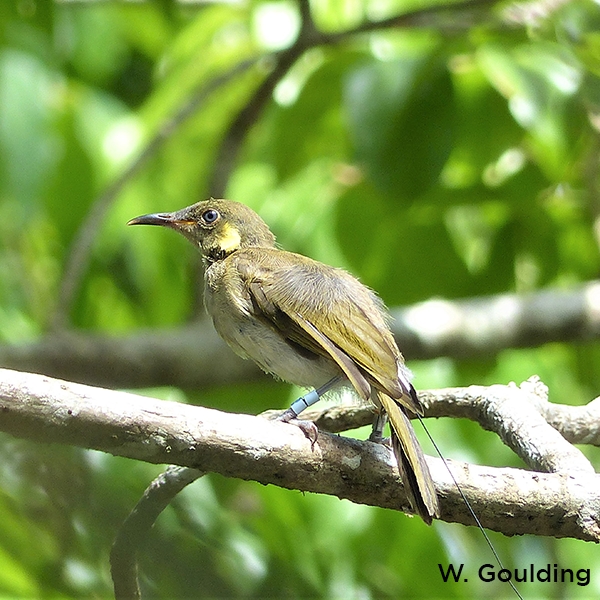
Are there two species of Graceful Honeyeater in Australia?
Lloyd Nielsen
pp. 149-157
Abstract
Two subspecies of Graceful Honeyeater Meliphaga (Microptilotis) gracilis are recognised in north-eastern Queensland: imitatrix inhabiting the Wet Tropics and gracilis inhabiting northern Cape York Peninsula. Vocalisations differ greatly between the two, so the strong possibility emerges that they are distinct species. The ranges of these taxa are separated by ~140 km in the vicinity of Cape Flattery–Princess Charlotte Bay on the eastern coast of Cape York Peninsula. Significantly, a thorough search confirms that there have been no specimens collected from this geographical gap between the two populations and previously suspected intergradation does not occur. This paper describes the considerable differences between the two, especially with respect to vocalisations, and suggests that these taxa represent distinct species.
References
Alström[JH1] , P. & Ranfft, R. (2003). The use of sounds in bird systematics and the importance of bird sound archives. Bulletin of the British Ornithologists’ Club (Suppl.) 123A, 114–135.
Baptista, L.F. & Kroodsma, D.E. (2001). Avian bioacoustics. In: del Hoyo, J., Elliott, A. & Sargatal, J. (Eds). Handbook of the Birds of the World, Volume 6: Mousebirds to Hornbills, pp. 11–52. Lynx Edicions, Barcelona, Spain.
Beehler, B.McP. (1978). Upland Birds of Northeastern New Guinea — A Guide to the Hill and Mountain Birds of Morobe Province. Wau Ecology Institute, Wau, PNG.
Beehler, B.M. & Pratt T.K. (2016). Birds of New Guinea: Distribution, Taxonomy, and Systematics. Princeton University Press, Princeton, New Jersey, USA.
Bortolussi, G. (2010). Mungkan Kandju National Park trip report. Contact Call March 2010, 5.
Coates, B.M. (1990). The Birds of New Guinea, Volume II. Dove Publications, Brisbane.
Diamond, J.M. (1972). Avifauna of the Eastern Highlands of New Guinea. Nuttall Ornithological Club, Massachusetts, USA.
Ford, J. (1983). Speciation in the ground-thrush complex Zoothera dauma in Australia. Emu 83, 141–151.
Ford, J. & Parker, S.A. (1973). A second species of wedgebill? Emu 73, 113–118.
Garnett, S. & Cox, J. (1988). Birds of the Townsville Town Common. 2nd edn. Queensland National Parks & Wildlife Service, Townsville, Qld.
Gould, J. (1866). Additions to the list of the avifauna of Australia with descriptions of three new species. Proceedings of the Zoological Society of London 1866, 217–218.
Gregory, P. (2017). Birds of New Guinea, Including Bismarck Archipelago and Bougainville. Lynx Edicons, Barcelona, Spain.
Hardy, J.W. & Van Gessel, F.W. (1994). Comparative measurements of the Graceful and Yellow-spotted Honeyeaters. Corella 18, 30.
Higgins, P.J., Peter, J.M. & Steele, W.K. (Eds) (2001). Handbook of Australian, New Zealand & Antarctic Birds, Volume 5: Tyrant-flycatchers to Chats. Oxford University Press, Melbourne.
IOC (International Ornithological Committee) (2017). World Bird List 2017, v. 7.1. Available online: http://www.worldbirdnames.org (retrieved 5 January 2018).
Joseph, L., Toon, A., Nyári, Á.S., Langmore, N.W., Rowe, M.C., Haryoko, T., Trueman, J. & Gardner, J. (2014). A new synthesis of the molecular systematics and biogeography of honeyeaters (Passeriformes: Meliphagidae) highlights biogeographical and ecological complexity of a spectacular avian radiation. Zoologica Scripta 43, 235–248.
King, B. (2005). The taxonomic status of the three subspecies of Cuculus saturatus. Bulletin of the British Ornithologists’ Club 125, 48–55.
Lanyon, W.E., (1978). Revision of the Myiarchus flycatchers of South America. Bulletin of the American Museum of Natural History 161, 429–627.
Marki, P.Z., Jønsson, K., Irestedt, M., Nguyen, J.M.T., Rahbek, C. & Fjeldså, J. (2017). Supermatrix phylogeny and biogeography of the Australasian Meliphagides radiation (Aves: Passeriformes). Molecular Phylogenetics and Evolution 107, 516–529.
Mathews, G.M. (1912). A reference-list to the birds of Australia. Novitates Zoologicae 18, 171–446.
McLean, J.A. (1995). The Meliphagidae of the Cooktown area, north Queensland. Sunbird 25, 63–70.
Miller, E.T. & Wagner, S.K. (2014). The vocalisations and species status of the White-lined and Kimberley Honeyeaters. Emu 114, 116–120.
Miller, E.T. & Wagner, S.K. (2015). The ecology of the Australian sandstone Meliphaga honeyeater species. Australian Field Ornithology 32, 38–52.
Norman, J.A., Rheindt, F.E., Rowe, D.L. & Christidis, L.C. (2007). Speciation dynamics in the Australo-Papuan Meliphaga honeyeaters. Molecular Phylogenics and Evolution 42, 80–91.
Peñalba, J.V., Mason, I.J., Schodde, R., Moritz, C. & Joseph, L. (2017). Characterizing divergence through three adjacent Australian avian transition zones. Journal of Biogeography 44, 2247–2258.
Pratt, T.K. & Beehler, B.M. (2015). Birds of New Guinea. 2nd edn. Princeton University Press, Princeton, New Jersey, USA.
Queensland Government (2018). Request a species list. Available online: https://environment.ehp.qld.gov.au/report-request/species-list (retrieved 12 January 2018).
Rand, A.L. (1936). Results of the Archbold Expeditions. No. 11 Meliphaga analoga and its allies. American Museum Novitates 872, 1–23.
Sangster, G., King, B.F., Verbelen, P. & Trainor, C.R. (2013). A new owl species of the genus Otus (Aves: Strigidae) from Lombok, Indonesia. PLoS One 8, e53712.
Schodde R. & Mason I.J. (1999). The Directory of Australian Birds: Passerines. CSIRO Publishing, Melbourne.
Storr, G.M. (1973). List of Queensland Birds. Western Australian Museum Special Publication No. 5. Western Australian Museum, Perth.
Wieneke, J. (2010). Where to Find Birds in North-east Queensland. Author, Townsville, Qld.
Xia, C., Liang, W., Carey, G.J. & Zhang, Y. (2016). Song characteristics of Oriental Cuckoo Cuculus optatus and Himalayan Cuckoo Cuculus saturatus and implications for taxonomy and distribution. Zoological Studies 55, [JH2]38.