
Interactions between Australian Ravens and raptors in a pastoral area of New South Wales: Interspecific aggression and nest-site spacing
Alice Bauer, Paul McDonald
pp. 1-7
Abstract
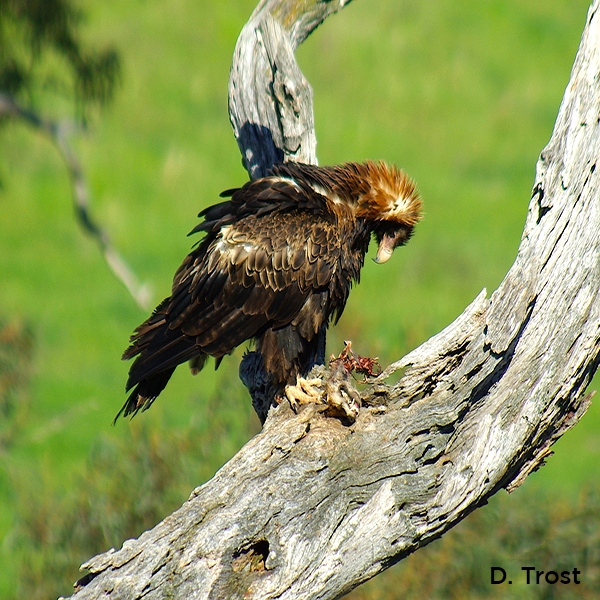
This study, near Tamworth, New South Wales, investigated the interactions within a diurnal raptor and Australian Raven Corvus coronoides community. The Australian Raven (hereafter ‘Raven’) is an abundant breeding resident here, is the only corvid that breeds in the area, and is known to have a close association with many raptor species. It is known to interfere with nests, provide frequent harassment and decrease the breeding productivity of several nesting raptor species, yet few studies have been completed on this issue, and its significance remains unknown. The abundance of raptors and Ravens and diversity of raptor species were determined from weekly surveys along a fixed 60-km transect in autumn to late spring 2016. A negative association was found between raptor species diversity and Raven abundance. The density and distribution of active or potential raptor and Raven nests were also recorded along the transect: active raptor nests had significantly more active stick nests of other species (raptors and Ravens) nearby (within 500 m), whereas active Raven nests had fewer such active nests within 500 m. Intruding Ravens and Wedge-tailed Eagles Aquila audax elicited significantly higher rates of defensive interactions from nesting Black Falcons Falco subniger than did other diurnal raptor species; Ravens triggered the highest rate of response. An increased understanding of the factors responsible for shaping community structure is useful for the management of threatened species. The raptor assemblage around Tamworth includes five threatened species, at least four of which are known to breed there, making competition for nest-sites here worthy of research.
References
Aumann, T. (2001a). Habitat use, temporal activity patterns and foraging behaviour of raptors in the south-west of the Northern Territory, Australia. Wildlife Research 28, 365–378.
Aumann, T. (2001b). The structure of raptor assemblages in riparian environments in the south-west of the Northern Territory, Australia. Emu 101, 293–304.
Aumann, T. (2001c). An intraspecific and interspecific comparison of raptor diets in the south-west of the Northern Territory, Australia. Wildlife Research 28, 379–393.
Aumann, T. (2001d). Breeding biology of raptors in the south-west of Northern Territory, Australia. Emu 101, 305–315.
Aumann, T.A., Baker-Gabb, D.J. & Debus, S.J.S. (2016). Breeding diets of four raptor species in the Australian tropics. Corella 40, 13–16.
Baker-Gabb, D.J. (1984a). The breeding ecology of twelve species of diurnal raptor in north-western Victoria. Australian Wildlife Research 11, 145–160.
Baker-Gabb, D.J. (1984b). The feeding ecology and behaviour of seven species of raptor overwintering in coastal Victoria. Australian Wildlife Research 11, 517–532.
Bates, D., Mächler, M., Bolker, B.M. & Walker, S.C. (2015). Fitting linear mixed-effects models using lme4. Journal of Statistical Software 67, 1–48.
Brambilla, M., Rubolini, D. & Guidali, F. (2004). Rock climbing and raven Corvus corax occurrence depress breeding success of cliff-nesting peregrines Falco peregrinus. Ardeola 51, 425–430.
Bureau of Meteorology (2016a). Average annual, seasonal and monthly rainfall. Available online: http://www.bom.gov. au/climate/dwo/IDCJDW2127.latest.shtml (retrieved 20 November 2016).
Carrete, M., Sánchez-Zapata, J.A., Calvo, J.F. & Lande, R. (2005). Demography and habitat availability in territorial occupancy of two competing species. Oikos 108, 125–136.
Charley, D., Lutter, H. & Debus, S.J.S. (2014). Breeding behaviour and prey of Black Falcons, Falco subniger, including foodcaching. South Australian Ornithologist 40, 11–30.
Chesson, P. (2000). Mechanisms of maintenance of species diversity. Annual Review of Ecology and Systematics 31, 343–366.
Corbett, L., Hertog, T. & Estbergs, J. (2014). Diet of 25 sympatric raptors at Kapalga, Northern Territory, Australia 1979-89, with data on prey availability. Corella 38, 81–94.
Debus, S. (2009). Threatened raptors. Bird Observer 860, 25.
Debus, S. (2012). Birds of Prey of Australia: A Field Guide. 2nd edn. CSIRO Publishing, Melbourne.
Debus, S. (2015). A possible supplementary management strategy for the Black Falcon. Boobook 33, 43–44.
Debus, S.J.S. & Olsen, J. (2010). Some aspects of the biology of the Black Falcon Falco subniger. Corella 35, 29–36.
Debus, S.J.S. & Tsang, L.R. (2011). Notes on Black Falcons Falco subniger breeding near Tamworth, New South Wales. Australian Field Ornithology 28, 13–26.
Debus, S.J.S. & Zuccon, A.E. (2013). Observations on hunting and breeding behaviour of the Black Falcon Falco subniger. Sunbird 43, 12–26.
Debus, S.J.S., Bauer, A.L. & Mitchell, G.I. (2017a). Breeding biology, behaviour and foraging ecology of the Black Falcon Falco subniger near Tamworth, New South Wales. Corella 41, 71–82.
Debus, S.J.S., Bauer, A.L. & van Gessel, F.W. (2017b). Calls and vocal behaviour of the Black Falcon Falco subniger. Corella 41, 83–87.
Falkenberg, I.D., Hurley, V.G. & Stevenson, E. (2000). The impact of Rabbit Calicivirus Disease on raptor reproductive success in the Strzelecki Desert, South Australia: A preliminary analysis. In: Chancellor, R.D. & Meyburg, B.-U. (Eds). Raptors at Risk, pp. 535–542. Hancock House, Surrey, UK, and World Working Group on Birds of Prey & Owls, Berlin.
Gainzarain, J., Arambarri, R. & Rodriguez, A. (2000). Breeding density, habitat selection and reproductive rates of the Peregrine Falcon Falco peregrinus in Alava (northern Spain). Bird Study 47, 225–231.
Garcia, J.T. & Arroyo, B.E. (2002). Intra- and interspecific agonistic behaviour in sympatric harriers during the breeding season. Animal Behaviour 64, 77–84.
Hakkarainen, H. & Korpimäki, E. (1996). Competitive and predatory interactions among raptors: An observational and experimental study. Ecology 77, 1134–1142.
Hakkarainen, H., Mykr, S., Kurki, S., Tornberg, R. & Jungell, S. (2004). Competitive interactions among raptors in boreal forests. Oecologia 141, 420–424.
Hardin, G. (1960). The competitive exclusion principle. Science 131, 1292–1297.
Higgins, P.J., Peter, J.M. & Cowling, S.J. (Eds) (2006). Handbook of Australian, New Zealand & Antarctic Birds, Volume 7: Boatbill to Starlings. Oxford University Press, Melbourne.
Hillerislambers, J., Adler, P.B., Harpole, W.S., Levine, J.M. & Mayfield, M.M. (2012). Rethinking community assembly through the lens of coexistence theory. Annual Review of Ecology, Evolution and Systematics 43, 227.
Jaksić, F.M. (1982). Inadequacy of activity time as a niche difference: The case of diurnal and nocturnal raptors. Oecologia 52, 171–175.
Jaksić, F.M. & Braker, H.E. (1983). Food-niche relationships and guild structure of diurnal birds of prey: Competition versus opportunism. Canadian Journal of Zoology 61, 2230–2241.
Jiménez-Franco, M., Martinez, J.E. & Calvo, F. (2011). Territorial occupancy dynamics in a forest raptor community. Oecologia 166, 507–516.
Krüger, O. (2004). The importance of competition, food, habitat, weather and phenotype for the reproduction of Buzzard Buteo buteo. Bird Study 51, 125–132.
Marchant, S. & Higgins, P.J. (Eds) (1993). Handbook of Australian, New Zealand & Antarctic Birds, Volume 2: Raptors to Lapwings. Oxford University Press, Melbourne.
Martínez, J.E., Martínez, H.A., Zuberogoitia, I., Zabala, J.,Redpath, S.M. & Calvo, J.F. (2008). The effect of inter- and intraspecific interactions on the large-scale distribution of cliffnesting raptors. Ornis Fennica 85, 13–21.
McDonald, P.G., Olsen, P.D. & Baker-Gabb, D.J. (2003). Territory fidelity, reproductive success and prey choice in the Brown Falcon, Falco berigora: A flexible bet-hedger? Australian Journal of Zoology 51, 399–414.
McDonald, P.G., Olsen, P.D. & Cockburn, A. (2004). Weather dictates reproductive success and survival in the Australian Brown Falcon Falco berigora. Journal of Animal Ecology 73, 683–692.
Olsen, J. (2014). Australian High Country Raptors. CSIRO Publishing, Melbourne.
Olsen, J., Debus, S., Rose, A.B. & Hayes, G. (2004). Breeding success, cliff characteristics and diet of Peregrine Falcons at high altitude in the Australian Capital Territory. Corella 28, 33–37.
Olsen, J., Fuentes, E., Rose, A.B. & Trost, S. (2006). Food and hunting of eight breeding raptors near Canberra, 1990–1994. Australian Field Ornithology 23, 77–95.
Oro, D., Pérez-Rodríguez, A., Martínez-Vilalta, A., Bertolero, A., Vidal, F. & Genovart, M. (2009). Interference competition in a threatened seabird community: A paradox for a successful conservation. Biological Conservation 142, 1830–1835.
Pianka, E.R. (2000). Evolutionary Ecology. 6th edn. Benjamin Cummings, San Francisco, California, USA.
Poole, K.G. & Bromley, R.G. (1988). Interrelationships within a raptor guild in the central Canadian Arctic. Canadian Journal of Zoology 66, 2275–2282.
Potapov, E. & Sale, R. (2005). The Gyrfalcon. Yale University Press, New Haven, Connecticut, USA.
Ratcliffe, D. (2010). The Peregrine Falcon. 2nd edn. Poyser, London.
R Core Team (2015). R: A language and environment for statistical computing. R Foundation for Statistical Computing, Vienna. Available online: https://www.R-project.org/ (retrieved 20 November 2016).
Rowley, I. (1969). An evaluation of predation by ‘crows’ on young lambs. Wildlife Research 14, 153–179.
Rowley, I. (1973). The comparative ecology of Australian corvids. II. Social organization and behaviour. Wildlife Research 18, 25–65.
Sarà, M., Mascara, R. & López-López, P. (2016). Understanding the coexistence of competing raptors by Markov chain analysis enhances conservation of vulnerable species. Journal of Zoology 299, 163–171.
Sergio, F. & Hiraldo, F. (2008). Intraguild predation in raptor assemblages: A review. Ibis 150, 132–145.
Sergio, F., Rizzolli, F., Marchesi, L. & Pedrini, P. (2004). The importance of interspecific interactions for breeding-site selection: Peregrine Falcons seek proximity to Raven nests. Ecography 27, 818–826.
Solonen, T. (1993). Spacing of birds of prey in southern Finland. Ornis Fennica 70, 129–143.
Spellerberg, I.F. & Fedor, P.J. (2003). A tribute to Claude Shannon (1916–2001) and a plea for more rigorous use of species richness, species diversity and the Shannon–Wiener Index. Global Ecology and Biogeography 12, 177–179.
Temeles, E.J. (1990). Northern Harriers on feeding territories respond more aggressively to neighbors than to floaters. Behavioral Ecology and Sociobiology 26, 57–63.
Thirgood, S.J., Redpath, S.M. & Graham, I.M. (2003). What determines the foraging distribution of raptors on heather moorland? Oikos 100, 15–24.
Treinys, R., DementaviÄius, D., Mozgeris, G., Skuja, S., Rumbutis, S. & StonÄius, D. (2011). Coexistence of protected avian predators: Does a recovering population of White-tailed Eagle threaten to exclude other avian predators? European Journal of Wildlife Research 57, 1165–1174.