
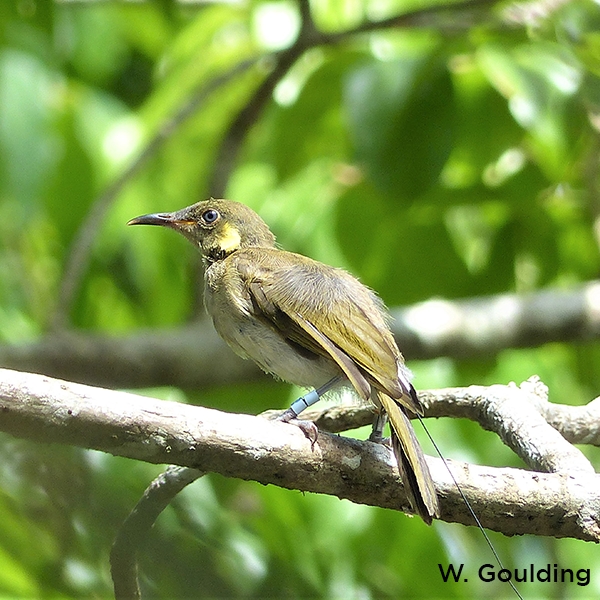
The significance of Nimalaica Wetland for Brown Honeyeaters in the Broome region, Western Australia
Jan Lewis
pp. 178-186
Abstract
Nimalaica Wetland, 22 km north of Broome, Western Australia, is listed as a Wetland of National Importance. This study documents the non-waterbird avian community of the Wetland, particularly with regard to seasonality of occurrence and dispersal of passerines from 2000 to 2010. Mist-netting was utilised. Fifty-two per cent of birds caught were Brown Honeyeaters Lichmera indistincta, with data strongly indicating that this species was visiting the Wetland between March and August to breed. The presence of a cryptic species—Little Grassbird Megalurus gramineus—not previously recorded in the Broome area was also revealed.
References
Barrett, G., Silcocks, A., Barry, S., Cunningham, R. & Poulter, R. (2003). The New Atlas of Australian Birds. Birds Australia, Melbourne.
BirdLife Australia (2015). Little Grassbird. Birds in Backyards. Available online: www.birdsinbackyards.net/species/Megalurus-gramineus (retrieved 29 March 2015).
Brennan, K. (1983). The Little Grassbird Megalurus gramineus in the north-eastern Kimberley, Western Australia. Emu 83, 115–116.
Collins, P. (1995). The Birds of Broome. An Annotated List. Broome Bird Observatory, Broome, WA.
Department of the Environment (2015). Directory of Important Wetlands in Australia. Willie Creek wetlands. Site WA022. Available online: http://www.environment.gov.au/cgi-bin/wetlands/search.pl?smode=DOIW (retrieved 27 March 2015).
de Rebeira, P. (2006). Banders Guide to the Birds of Western Australia. Western Banders Association, Glenn Forrest, WA.
Higgins, P.J., Peter, J.M. & Steele, W.K. (Eds) (2001). Handbook of Australian, New Zealand & Antarctic Birds, Volume 5: Tyrantflycatchers to Chats. Oxford University Press, Melbourne.
Johnstone, R.E. & Darnell, J.C. (2015). Checklist of the Birds of Western Australia. Western Australian Museum, Perth. Available online: http://museum.wa.gov.au/research/departments/terrestrial-zoology/checklist-terrestrialvertebrate-fauna-western-australia (retrieved 9 November 2015).
Johnstone, R.E. & Storr, G.M. (2004). Handbook of Western Australian Birds, Volume II: Passerines. Western Australian Museum, Perth.
Johnstone, R.E., Burbidge, A.H. & Darnell, J.C. (2013). Birds of the Pilbara region, Western Australia, including seas and offshore islands: Distribution, status and historical changes. Records of the Western Australian Museum, Supplement 78, 343–441.
Keast, A. (1968). Seasonal movements in the Australian honeyeaters (Meliphagidae) and their ecological significance. Emu 67, 159–209.
Kenneally, K.F., Choules Edinger, D. & Willing, T. (1996). Broome and Beyond. Plants and People of the Dampier Peninsula, Kimberley, Western Australia. Department of Conservation & Land Management and Broome Botanical Society, Como, WA.
Lewis, J. (2013). Observations on the relationships between birds on the Broome Peninsula and the “Mangarr on relict dunes systems” vegetation community. Amytornis 5, 15–21.
Lowe, K. (1989). The Australian Bird Bander’s Manual. Australian National Parks & Wildlife Service, Canberra.
Nyamba Buru Yawuru (2013). Yawuru Land and Sea. Available online: http://www.yawuru.com/our-organisation/land-sea/ (retrieved 27 March 2015).
Rogers, K., Rogers, A. & Rogers, D. (1986). Banders Aid. A Guide to Ageing and Sexing Bush Birds. A. Rogers, St Andrews, Vic.
Torres, M. (1998). Nimalaica wetlands. In: Whitehead, P., Storrs, M., McKaige, M., Kennett, R. & Douglas, M. (Eds). Wise Use of Wetlands in Northern Australia: Indigenous Use. Proceedings of a workshop held at Batchelor College, Batchelor, Northern Territory, 29 & 30 September & 1 October 1998, pp. 42–45. Centre for Tropical Wetlands Management and Centre for Indigenous Natural & Cultural Resource Management, Northern Territory University, Darwin.
Woinarski, J.C.Z. (2006). Predictors of nomadism in Australian birds: A reanalysis of Allen and Saunders (2002). Ecosystems 9, 689–693.
Woinarski, J.C.Z. & Tidemann, S.C. (1991). The bird fauna of a deciduous woodland in the wet-dry tropics of northern Australia. Wildlife Research 18, 479–500.