
An unprecedented irruption and breeding of Flock Bronzewings Phaps histrionica in central South Australia
Reece D. Pedler, Catherine E. Lynch
pp. 1-13
Abstract
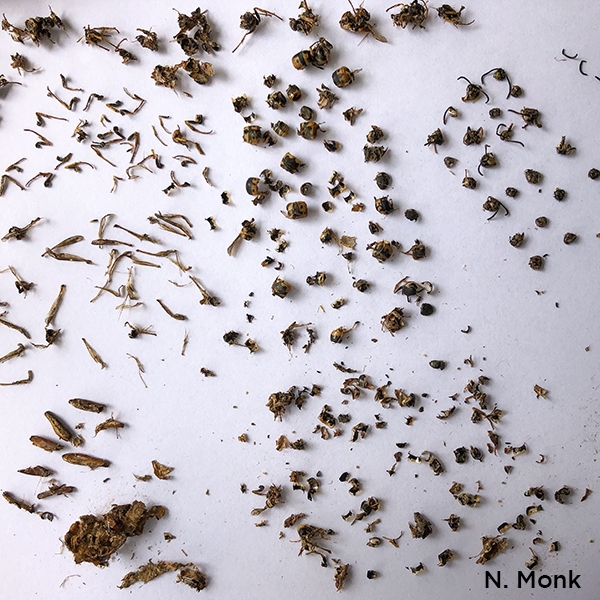
The Flock Bronzewing Phaps histrionica has declined significantly and undergone a northward range contraction in inland Australia since European settlement. In the southern parts of its range, including central northern South Australia, it is uncommonly recorded during times of significant ephemeral vegetation response, triggered by sustained above-average rainfall. In late 2013, while core habitats in Queensland were in extended drought and much of arid South Australia received below-average rainfall, an area of ~10 000 km2 between Roxby Downs and Lake Eyre South supported tens of thousands of Flock Bronzewings, with evidence of widespread successful breeding during September and October and contemporary range expansions of 150 km to the south and west. Through a network of local pastoralists, mining workers and biologists we collated ˃80 field observations from >40 observers across this region. Direct evidence of predation by Cats Felis catus was detected at a nest-site and in the stomach of a cat shot in the area. Seeds of annual shrubs Trichodesma and Phyllanthus species dominated the crop contents of two dead fledgling Bronzewings that were collected opportunistically. Although the Flock Bronzewing is well known for its irruptive nature, the magnitude and southerly extent of this sustained irruption are unprecedented in the literature and in the living memory of local observers. This event exemplifies the remarkable ability of arid-adapted birds to locate and exploit localised productive habitat within vast dynamic and stochastic landscapes, in this case recruiting new individuals to the population despite widespread unfavourable conditions within their core range.
References
Bureau of Meteorology (2011). Rainfall deciles for Australia. Available online: www.bom.gov.au (retrieved 19 May 2012).
Bureau of Meteorology (2014). Australian rainfall deficiencies: 16 months. Available online: www.bom.gov.au (retrieved
27 February 2014).
Carpenter, G. (2011). Bird records. Birds SA Newsletter 219, 17–20.
Carpenter, G. (2014). Bird records. Birds SA Newsletter 229, 13–15.
Cogger, H. (2014). Reptiles and Amphibians of Australia. 7th edn. CSIRO Publishing, Melbourne.
Dostine, P.L. (2009). The Ecology and Conservation of the Flock Bronzewing Pigeon Phaps histrionica. PhD Thesis. Australian National University, Canberra.
Dostine, P.L., Woinarski, J.C.Z., Mackey, B. & Nix, H. (2014). Patterns of grassland productivity, composition and seed abundance, and the diet of the flock bronzewing pigeon Phaps histrionica at one site in northern Australia over a period of marked seasonal change. Wildlife Research 41, 343–355.
Fisher, C.D., Lindgren, E. & Dawson, W.R. (1972). Drinking patterns and behaviour of Australian desert birds in relation to their ecology and abundance. Condor 74, 111–136.
Fraser, T. (1990). Observations of the Flock Pigeon in South Australia. South Australian Ornithologist 31, 13–15.
Frith, H.J. (1982). Pigeons and Doves of Australia. Rigby Publishers, Adelaide.
Frith, H.J., Wolfe, T.O. & Barker, R.D. (1976). Food of eight species of Columbidae, in the genera Geopelia, Phaps, Geophaps and Petrophassa. Australian Wildlife Research 3, 159–171.
Garnett, S. & Crowley, G. (2000). The Action Plan for Australian Birds 2000. Environment Australia, Canberra.
Higgins, P.J. &. Davies, S.J.J.F. (Eds) (1996). Handbook of Australian, New Zealand & Antarctic Birds, Volume 3: Snipe to Pigeons. Oxford University Press, Melbourne.
Kingsford, R.T., Roshier, D.A. & Porter, J.L. (2010). Australian waterbirds – time and space travellers in dynamic desert landscapes. Marine and Freshwater Research 61, 875–884.
Lynch, C. (2014). Arid Recovery Bettong Overpopulation Management. Unpublished report to Arid Recovery Scientific Advisory Committee, Roxby Downs, SA.
MacGillivray, W. (1932). The flock pigeon (Histriophaps histrionica). Emu 31, 169–174.
McAllan, I.A.W. (1996). The Flock Bronzewing Phaps histrionica in New South Wales, with comments on its biology. Australian Bird Watcher 16, 175–204.
Moseby, K.E., Hill, B.M. & Read, J.L. (2009). Arid Recovery – a comparison of reptile and small mammal populations inside and outside a large rabbit, cat and fox-proof exclosure in arid South Australia. Austral Ecology 34, 156–169.
Pedler, R.D. (2010). Southerly observations of the Flock Bronzewing, Phaps histrionica, in South Australia between 2008 and 2010. South Australian Ornithologist 36, 25–32.
Read, J.L. & Badman, F.J. (1999). The Birds of the Lake Eyre South Region. Lake Eyre South Monograph Series v.3. Royal Geographical Society of South Australia, Adelaide.
Read, J. & Bowen, Z. (2001). Population dynamics, diet and aspects of the biology of feral cats and foxes in arid South Australia. Wildlife Research 28, 195–203.
Read, J. & Cunningham, R.B. (2010). Relative impacts of cattle grazing and feral animals on an Australian arid zone reptile and small mammal assemblage. Austral Ecology 35, 314–324.
Read, J., Bird, P. & Greenfield, C. (1996). Southern range extensions of the Flock Bronzewing Phaps histrionica in South Australia, including a breeding record. South Australian Ornithologist 32, 99–102.
Reese, L.R. (1924). Bird notes. South Australian Ornithologist 7, 229–230.
Reese, L.R. (1927). Bird notes. South Australian Ornithologist 9, 69.
Reese, L.R. (1931a). Bird notes. South Australian Ornithologist 11, 71–72.
Reese, L.R. (1931b). Bird notes. South Australian Ornithologist 11, 108, 170.
Reid, J. (1988). Birds. In: Reid, J. & Gillen, J. (Eds). The Coongie Lakes Study, pp. 179–226. Report to Department of Environment and Planning, Adelaide.
Reside, A.E, VanDerWal, J.J., Kutt, A.S. & Perkins, G.C. (2010). Weather, not climate, defines distributions of vagile bird species. PLoS ONE 5, e13569.
Robley, A., Short, J. & Bradley, S. (2001). Dietary overlap between the burrowing bettong (Bettongia lesueur) and the European rabbit (Oryctolagus cuniculus) in semi-arid coastal Western Australia. Wildlife Research 28, 341–349.
Rogers, C. (2011). Bird report 2009. South Australian Ornithologist 37, 32–42.
Roshier, D., Robertson, A.I., Kingsford, R.T. & Green, D.G. (2001). Continental-scale interactions with temporary resources may explain the paradox of large populations of desert waterbirds in Australia. Landscape Ecology 16, 547–556.
Secombe, N. (2012). Camel movement cameras detect rare pigeon. Across the Outback 61, 15.
Van Dyck, S., Gynther, I. & Baker, A. (Eds) (2013). Field Companion to the Mammals of Australia. New Holland Publishing, Sydney.
Ziembicki, M. & Woinarski, J.C.Z. (2007). Monitoring continental movement patterns of the Australian Bustard Ardeotis australis through community-based surveys and remote sensing. Pacific Conservation Biology 13, 128–142.